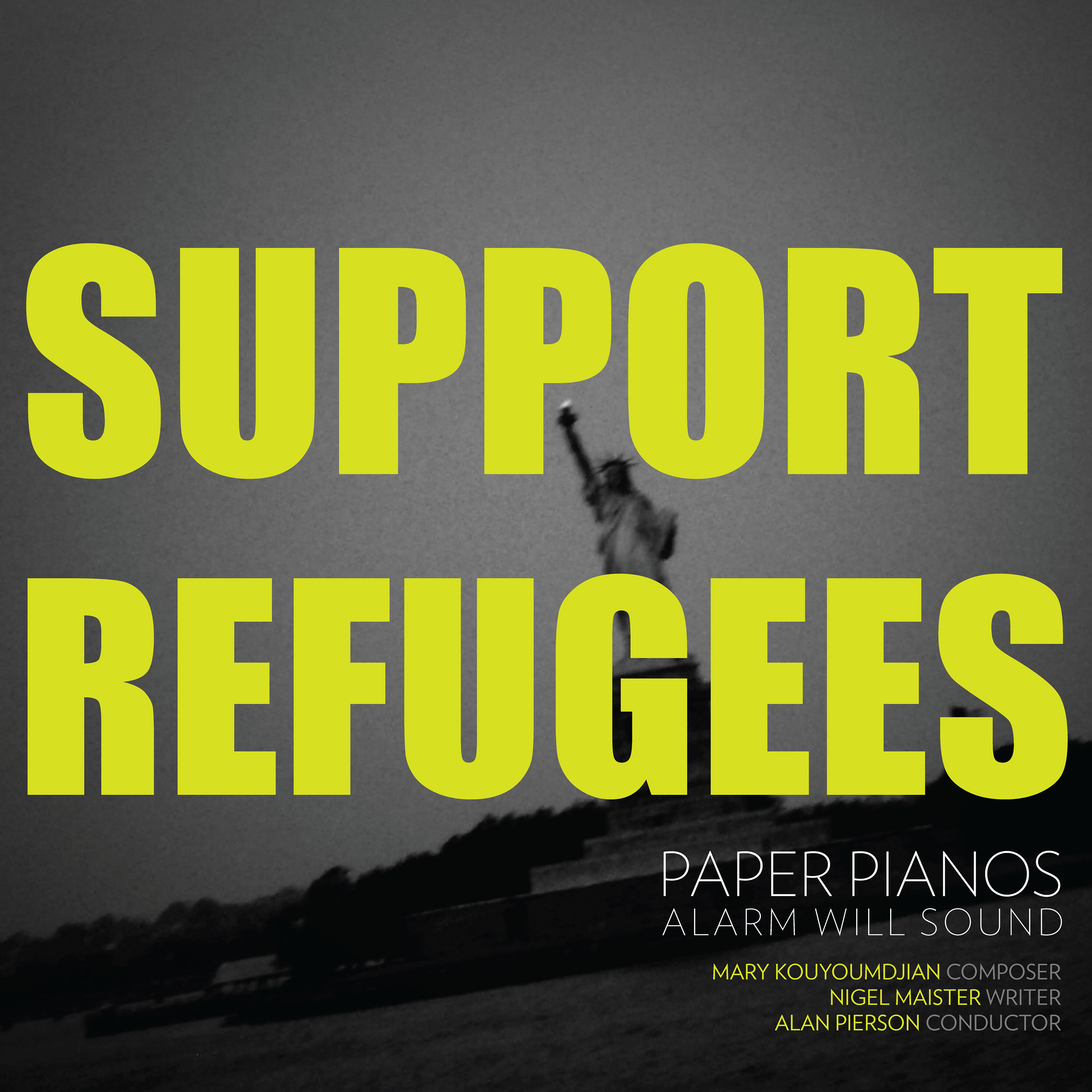
Paper Pianos
A live recording by Alarm Will Sound · Composed by Mary Kouyoumdjian · Text by Nigel Maister · Conducted by Alan Pierson
“A socially urgent multi-media work that boldly melds music and audio documentary with first-person stories of refugees, exploring how music serves as solace and inspiration under conditions of displacement.”
— 2024 Pulitzer Prize Committee
Artist proceeds support the IRC.
Artist proceeds from this recording benefit the International Rescue Committee, which delivers direct services to refugees and displaced people resettling in New York City and around the world.
Visit the IRCSix Movements
- IOverture: This is Not a Choice (Gee-Gee's Primer)
- IIChild of War
- IIIAll Good Things
- IVBad to Worse
- VFlight
- VIAn Open Fist
Music by Mary Kouyoumdjian. Text by Nigel Maister, edited from interviews conducted by Nigel Maister and Mary Kouyoumdjian. Interview recordings and audio editing by Mary Kouyoumdjian.
Nigel Maister
Much has changed since Mary Kouyoumdjian and I first started working on Paper Pianos. Beyond the turmoil of our broader, current world, the toxic politics of the United States and the brutality of our current political regime have made, not only our lives that much more fraught and laden with despair, but they have made this country—so long an emblem of plurality, diversity, and welcoming (however inconsistent and flawed)—an inwardly focused, xenophobic, and brutally hostile environment for those seeking a better, safer, and freer life. And the violence our government has meted out on foreign lands is, at the time of writing, both horrifying and deeply concerning when it comes to the displacement of peoples and the future of our ability to provide help to those in need.
What piqued my interest when we began this project, were the stories of those we seldom, if ever, hear from or about: the people who aid, resettle, comfort, greet on arrival, and provide orientation and guidance for newly arriving refugees, many who arrive on these shores with little more than their memories of home and the clothes on their backs. The public understanding of the refugee system ignores or is largely blind to the rigorous and time-consuming bureaucratic screening and processing that leaves individuals and families in limbo and imprisoned in squalid camps for years and, sometimes, for decades.
Equally, we tend to envision the refugee's arrival on our shores as an ending—the happy resolution of a long and arduous journey towards “freedom.” In fact, it's the beginning of another, equally difficult journey and one with very little governmental support. Brave and selfless non-governmental agencies shoulder the bulk of its burdens. Few of us can imagine what it would be like to arrive in a foreign place with little if any language skills or comprehension, facing cultural mores that are challenging at best, frightening at worst, and with only 90 days of assistance before one is expected to be self-sufficient and employed. It is a terrifying prospect.
Interviewing the four extraordinarily generous individuals whose stories make up Paper Pianos gave us insight into all these journeys. Though each story is unique, all share one element: that the gratitude they have for being given a second chance in this country is tempered by real and painful sacrifice: of family, friends, comfort, the familiar, dreams, aspirations, and more. When one considers the depth and the cost of their sacrifice, the current closing of this country's door to those who come here seeking safety and protection, who have paid dearly for the opportunity to become part of this country's “melting pot,” is shameful and egregious.
The text of the piece melds our interviews with our four protagonists into a structure that does not follow a strictly linear narrative. Instead, it collages them into a broadly thematic arc. It is anchored by Milad's story which forms a spine onto which the others' experiences are tethered. All the narratives share the experience of sacrifice and deliverance: though the nature of that deliverance is not always the one that had originally been dreamed of.
Just as Milad Yousufi's story of imagination, resilience, and determination in the face of war and terror, spoke originally to us of a kind of redemption from despair and loss through music, so we hope that Paper Pianos might provoke in the listener an empathy and greater understanding for the plight of those “huddled masses” that once were promised succor in these flawed and deeply troubled United States.
Mary Kouyoumdjian
I am the sister, daughter, cousin, niece, and granddaughter of refugees—from the Armenian Genocide, the Lebanese Civil War, and the conflicts that have continued in Lebanon since. These histories have profoundly shaped my work, drawing me toward themes of socio-political conflict, diasporic identity, and inviting understanding between audiences and storytellers through music-documentary practices. My own family was not in a position to speak openly about the atrocities they endured, and it is heartbreaking to witness history continue to repeat itself with ongoing global violence and displacement today. As a result, I feel both a deep responsibility and a strong urgency to use my own privilege—my freedom of expression—to draw attention to experiences of displacement.
Activism can take many different forms, and I believe the arts have a unique ability to speak difficult truths in hopes for a more promising reality. For my own work, my humble approach is to create projects that center on empathy: work that allows listeners to hear directly from real voices—individuals who have endured and persisted through humanitarian conflict—so seemingly distant experiences may resonate more closely through our shared desires for home, love, and freedom. It is my hope that this recognition can foster a more compassionate community—one more inclined to act. Paper Pianos is one realization of this hope, and it began from a simple gesture of kindness from Alarm Will Sound.
In 2016, Matt Marks—my late partner, composer/performer, and founding member of Alarm Will Sound—forwarded me an email from the ensemble's bassoonist, Michael Harley. Michael had written that his family member, an immigration lawyer, was representing a young and extraordinary pianist, Milad Yousufi, who had recently fled Kabul, Afghanistan. Milad's life had been threatened by extremists for being a musician; under Taliban rule, musical expression had been forbidden. Milad was in search of a piano to practice on, and, after an unforgettable meeting with Milad and his lawyer, I invited Milad into our home, where he was always welcome to our upright piano. As our friendship grew, Milad shared his remarkable story and unwavering commitment to music—describing how, while in hiding, he would draw piano keys on paper to practice in silence. He generously contributed interviews to Paper Pianos, driven by a desire to share his experience and to remind those of us in the United States of the freedoms we hold and too often take for granted.
While an early version of Paper Pianos centered solely on Milad's story, following the 2017 U.S. travel bans targeting predominantly Muslim countries, co-creator Nigel Maister and I expanded the project to include interviews with refugee resettlement workers, seeking to better understand the increasingly difficult process facing those arriving in New York State. What we learned was that each of the resettlement workers we spoke with had been refugees themselves, coming from different parts of the world and now dedicating their lives to supporting others through the immigration process. Raising one's voice is essential for any community to move forward, and so I am immensely grateful to Milad, Gee-Gee, Hani, and Akil for so generously sharing their stories and for the cherished gift of their trust.
Special thanks to Alarm Will Sound, Nigel Maister, Kevork Mourad, Afsoon Pajoufar, and Seth Reiser for their belief in this work and for their immense care in presenting these stories. As Milad shares in this piece, “If we close our heart like a fist, it will be closed completely. If you open it, you might find something interesting.”
Alarm Will Sound
Music Director: Alan Pierson
- Domenica Fossatiflute
- Christa Robinsonoboe and voice
- Bill Kalinkosclarinet
- Elisabeth Stimpertbass clarinet
- Michael Harleybassoon and voice
- Adedeji Ogunfoluhorn
- Tim Leopoldtrumpet
- Michael Clayvillebass trombone
- Chris P. Thompsonpercussion
- Matt Smallcombpercussion
- John Orfepiano
- Courtney Orlandoviolin and voice
- Andie Tanningviolin and voice
- Gillian Gallagherviola
- Norbert Lewandowskicello and voice
- Miles Brownbass
- Daniel Neumannaudio engineer
Interviewees
- Milad Yousufi
- Getachew Bashir
- Hani Ali
- Akil Aljaysh
Recording & Production
- Producers
- Mary Kouyoumdjian and Gavin Chuck
- Recording and Mixing Engineer
- Daniel Neumann
- Recorded Interviews and Electronics
- Mary Kouyoumdjian
- Mastering
- Bernd Klug
- Cover Art
- Nigel Maister, Mary Kouyoumdjian
- Graphic Design
- DM Stith
Staged at EMPAC
February 25, 2023 · EMPAC — Experimental Media and Performing Arts Center · Troy, NY
- Direction
- Nigel Maister
- Music Direction
- Alan Pierson
- Projection Design
- Kevork Mourad
- Scenic Design
- Afsoon Pajoufar
- Lighting Design
- Seth Reiser
The staged version of Paper Pianos, composed by Mary Kouyoumdjian and performed by Alarm Will Sound, was commissioned by EMPAC/Experimental Media and Performing Arts Center, Rensselaer Polytechnic Institute, Troy NY and supported by the National Endowment for the Arts and New Music USA, made possible by annual program support and/or endowment gifts from Mary Flagler Cary Charitable Trust, New York City Department of Cultural Affairs, Helen F. Whitaker Fund, The Aaron Copland Fund for Music, Inc., Rockefeller Brothers Fund, Howard Gilman Foundation, Anonymous.
Cantaloupe Music
- Executive Producers
- Michael Gordon, David Lang, Kenny Savelson, and Julia Wolfe
- Cantaloupe Club Producers Circle
- Patricia & Martin Angerman, Eric Scott Klein, Ken Nielsen, Roger Stude, and Ola Torstensson
- Label Manager
- Bill Murphy
- Licensing Manager
- Brian Petuch
- Recording Published By
- Track Pack Productions
- Libretto Published By
- legeNd productions
Paper Pianos was commissioned by Alarm Will Sound, and received additional support from the Cheswatyr Foundation; Charles S. Miller Award of Columbia University Music Department; Pacific Harmony Foundation; New York State Council on the Arts Individual Artist Composer Commission Grant with the support of the Office of the Governor and the New York State Legislature; National Endowment for the Arts; and a project grant from The MAP Fund. The MAP Fund is primarily supported by the Doris Duke Charitable Foundation. Additional funds come from the Andrew W. Mellon Foundation.
℗ & © 2026 Cantaloupe Music, LLC. All rights reserved. Cantaloupe Music is from the creators of Bang on a Can. UPC/EAN: 713746322328.
Content Advisory
This work includes pre-recorded sounds and interviews on topics of conflict and violence that some listeners may find disturbing, and may not be suitable for children.